Intelligence shouldn't be orchestrated.It should emerge.
Rhizome is an experimental runtime for multi-agent coordination — a substrate where tasks become tensions, agents form temporary coalitions, and software work becomes a visible cognitive field.
Rhizome currently runs autonomous multi-agent software work.
The same field, in practice — on real code, research, and logs. Not a slide deck: a running system that shows its work.
- →
Long-horizon autonomous runs
many coordination cycles on real software work, without a human driving each step.
- →
Artifact-bound tensions
work is decomposed into typed tensions tied to files and segments — not a static task list.
- →
Claims verified against evidence
checked against files, commits, logs, and tests; an agent's word is never proof of work.
- →
A traceable event stream
every attachment, coalition, merge, and verifier pass is exposed as a replayable log.
- →
Dissent & handoff preserved
disagreement and ownership survive resets, takeovers, and compaction.
Today's agent systems are orchestrated.
A central planner decides what happens, when, and by whom. Even with many agents, the shape stays command-and-control.
It works — until the planner becomes the thing every decision has to route through.
Coordination becomes the bottleneck.
Rhizome replaces orchestration with a field.
Work isn't assigned. It exists as tension — pressure in a shared cognitive field that agents can sense.
Agents don't execute commands. They attach by fit, form temporary coalitions, and disperse — without losing the thread.
The field, running
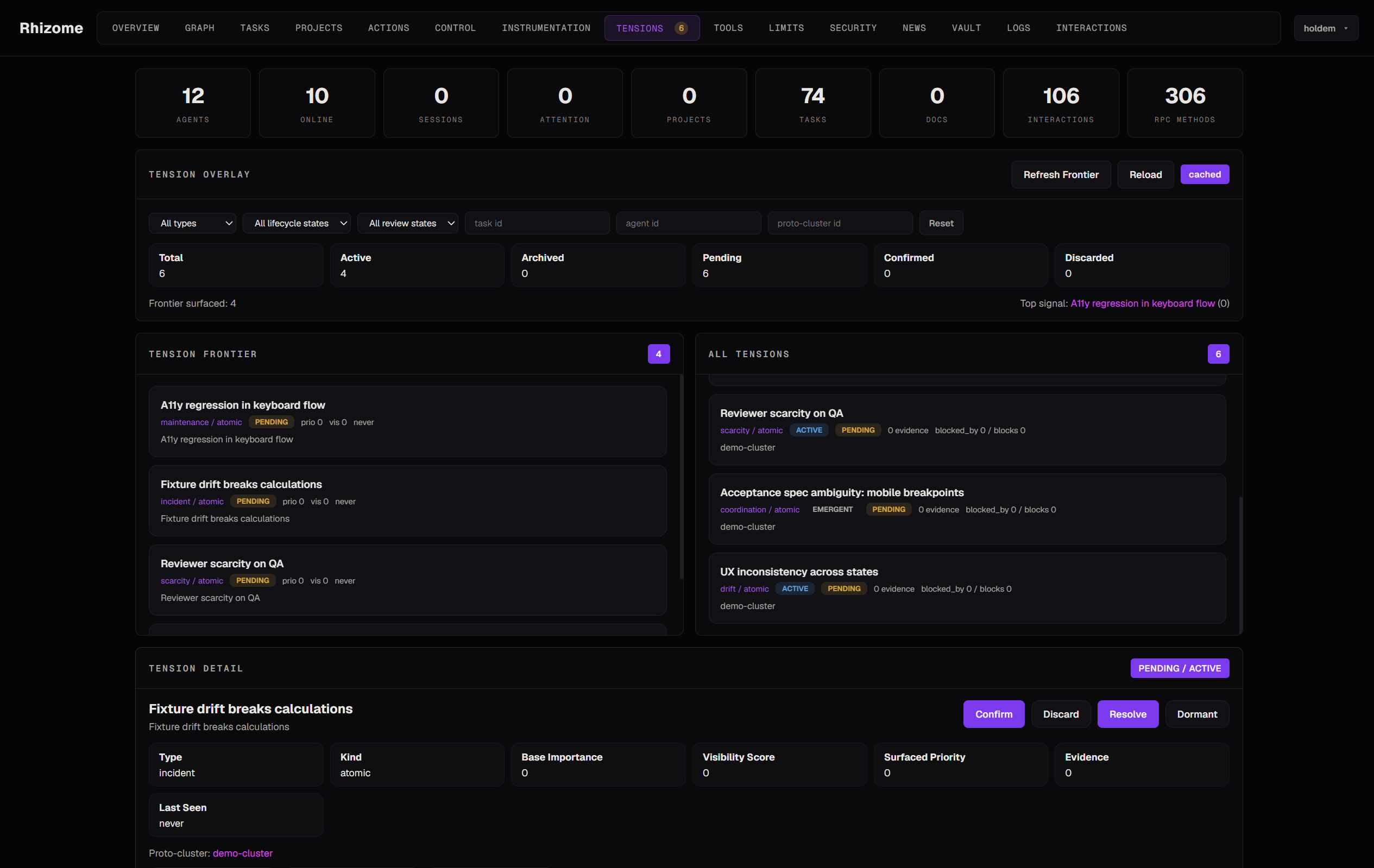
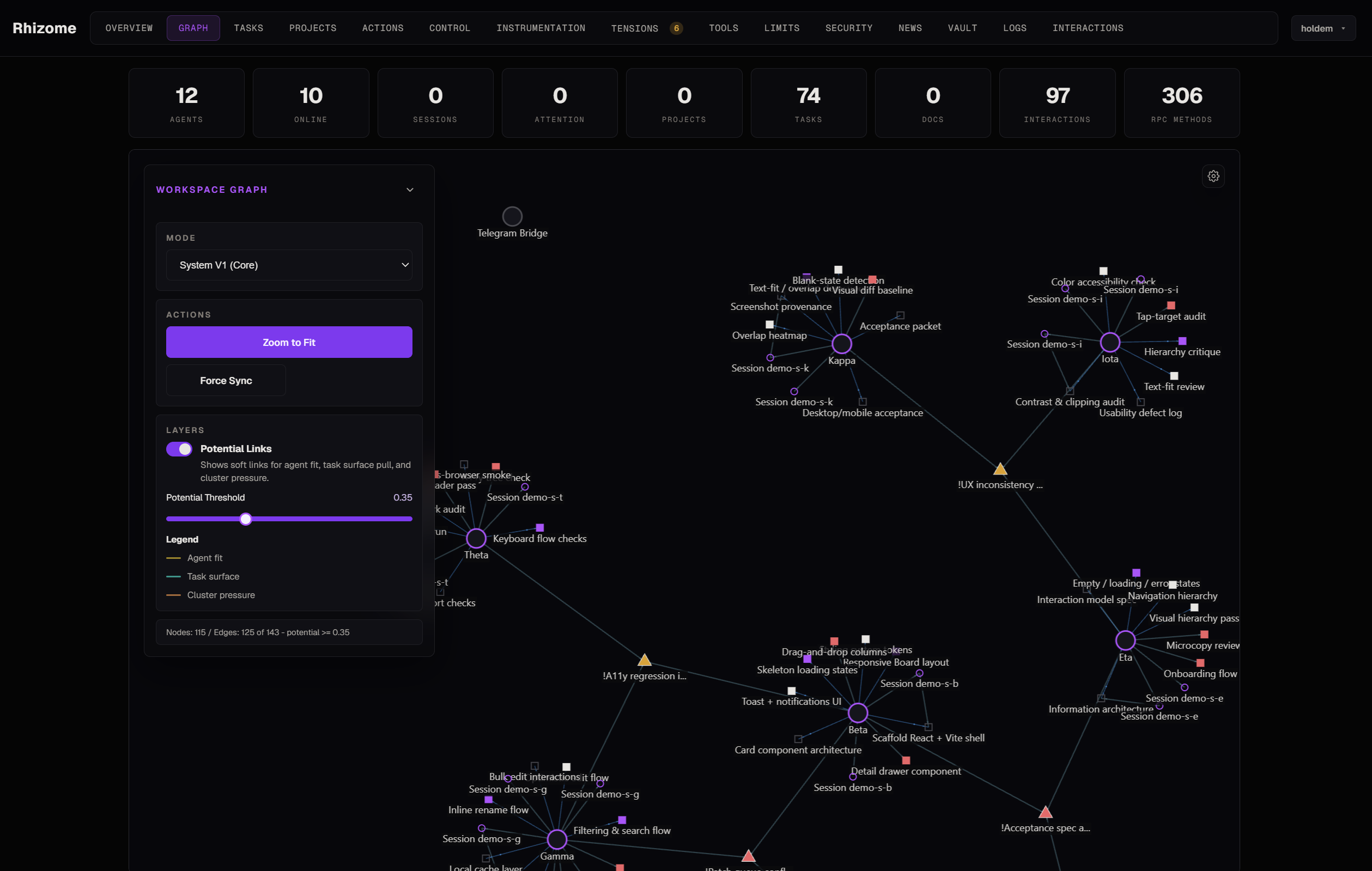
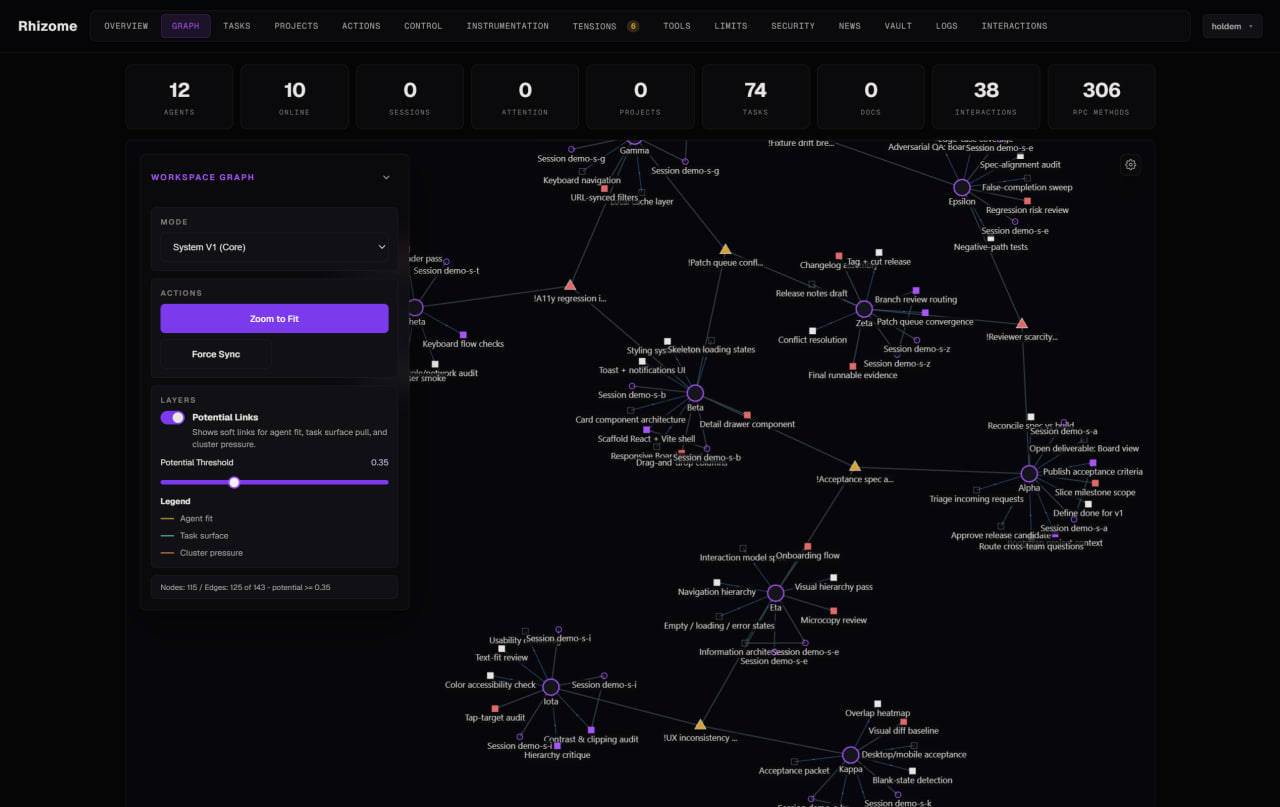
Tension Field
Work exists as tensions — gaps between the current and the desired state, each with a computed priority. Tasks aren't dispatched; they radiate pressure, decay when stale, and intensify when they block progress.
Agent Attachment
Each agent scores its fit against a tension — priority, capability, held context, crowding, authority — and binds where it is most useful. No central dispatcher. No static work queue. Just fit.
Temporary Coalitions
When a tension needs complementary skills, agents form a short-lived coalition, coordinate, and dissolve. Structure stays temporary; bureaucracy never sets in.
Verifier Mesh
Verification is distributed, not a final gate: cheap checks, semantic review, and adversarial audit. Claims must bind to artifacts and evidence — an agent's words are never proof of work.
Policy Engine
An adaptive policy loop watches the field — divergence, stagnation, consensus collapse — and shifts coordination modes to hold the system in the productive zone between rigid order and noise.
An illustrative coordination cycle — tension detection, agent attachment, coalition formation, and verification. The published run report lives in Early Signals.
A verifiable result from a real run.
Signal 01 is published: a three-agent autonomous build with source, commit history, run evidence, tests, and an explicit claim boundary.
Signals 02 and 03 remain in preparation. Their pages describe the planned research and coordination-trace reports; they are not published results.
Open Signal 01 and the roadmap→Traditional Model
Central control
Task assignment
Static workflows
Words count as done
Rhizome
No permanent central planner
Tension-driven attachment
Temporary coalitions
Evidence counts as done
Coordination Substrate
The durable control plane: projects, claims, a patch queue, authority-gated mutation, and evidence trails. Currently hardening the coordination contracts and runtime state machines.
Tension Field
Tasks become tensions with computed priority, staleness decay, and stagnation pressure. Agents attach by fit instead of assignment.
Mesh & Coalitions
Distributed verification with reviewer diversity, and temporary coalitions that form around high-value work and dissolve when it's done.
Visible Cognition
An adaptive policy engine regulating the field, and an interface where the distributed cognitive process is observable end to end.
If intelligence can emerge instead of being controlled,
we do not just improve AI —
we change how complex systems are built.